
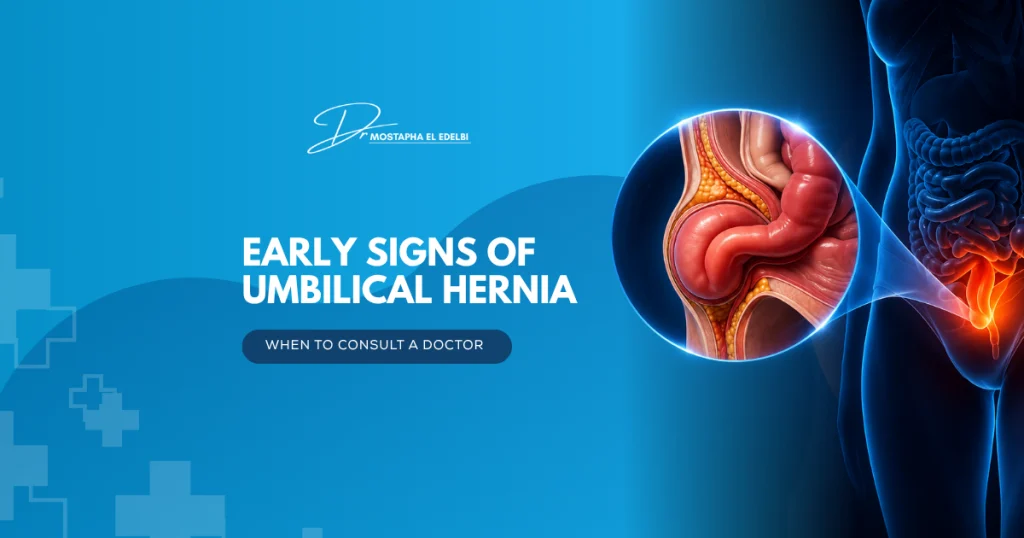
You notice a small swelling near your belly button while getting ready for work. It does not hurt so you do not think much about it. Then it appears again after a long walk. It is natural to wonder if it is something you should be concerned about. Many people experience the same situation. They ignore the early signs of umbilical hernia because the swelling comes and goes. Since there is little or no pain in the beginning so it is easy to believe the problem will disappear on its own. Unfortunately that is not how an umbilical hernia works. The weak area in the abdominal wall remains there and may become larger over time. Knowing what to look for can help you make the right decision at the right time.
A Small Bulge Is Often the First Sign
This symptom usually begins with a soft bulge near the belly button. You may only notice it while standing, coughing, laughing or lifting heavy things. The swelling may become smaller or disappear for a while when you lie down. That is exactly why many people ignore it. They assume it is nothing serious since the bulge is not always visible. It is still worth having it checked by a doctor even if the swelling comes and goes.
The Discomfort May Be Easy to Ignore
Not all hernias cause immediate pain. Some people experience only pulling or pressure around their navel. Others experience pain in their belly button area only when engaged in physical activities but feel fine when resting. These initial Umbilical hernia symptoms are confused with simple muscle pain or fatigue. Please do not hope that everything will be okay in case of recurrence.
Daily Activities May Start Feeling Different
There is one of the simplest ways of finding out you have a hernia. It can be done through your daily activities. It might become difficult for you when you are carrying heavy shopping bags or exercising as well as lifting your baby. These will increase the pressure in your abdominal area to help you feel the hernia. Then as time moves on pain from umbilical hernia may become more frequent. So this mild discomfort can slowly become part of your everyday life.
Why the Swelling Can Become Larger
A hernia does not stay the same at all times. The weak spots in the abdominal wall can gradually stretch that allow more tissue to push through. So a small lump that seemed harmless a few months ago may look much bigger today. Waiting cannot improve the condition fully. It simply gives the hernia more time to grow. So as soon as possible seek expert help when you notice these signs of umbilical hernia.
When to See a Doctor for Umbilical Hernia?
Many people believe that they have to wait for some time. But you must consult your doctor immediately after observing any difficulties. Understanding when to see a doctor for an umbilical hernia will make sure you do not face any problems in the future. It is not advisable to ignore any swelling or pain that increases with your everyday actions and the development of a lump over time.
What Will Happen During Your Appointment?
It is surprising to most people that the first appointment is pretty simple. The doctor asks the patient about the time when they started feeling swollen and if any particular activity makes it worse. Just a physical checkup is required to diagnose the cause of the problem in most cases. This process is called Umbilical hernia diagnosis. It helps your surgeon understand the size and position of the hernia before recommending the most suitable treatment.
Do Not Ignore Sudden Changes
Most of the time hernias progress gradually and sometimes the hernia may get incarcerated. This will cause reduced circulation of blood in the affected tissues and this needs urgent medical care. But you need to see an expert for help if the bulge discolors, is irreducible or painful.
Treatment Starts With the Right Advice
Most people believe that the swelling would go away with rest or by avoiding heavy lifting. But an umbilical hernia in adults does not usually heal without treatment. So surgery will help to repair the weak area of the abdominal wall and reduce the chances of any other problems in the future. This is why your doctor may suggest you to undergo an open or laparoscopic surgery based on your case. Are you searching for an experienced Hernia specialist in Dubai? Well, Dr. Mostapha El Edelbi offers personalized surgical treatments to his patients to help them recover safely and comfortably.
Conclusion
The signs of umbilical hernia will normally show up gradually. A tiny lump with slight pain or even sometimes discomfort may not seem like a big problem. But these initial symptoms should never be taken lightly. Consulting a surgeon will help you receive a definitive diagnosis and allow you to explore treatment options for yourself. Being aware of these symptoms today will make your treatment process much easier tomorrow.
Connect with Dr. Mostapha El Edelbi +97158 182 4633 now for more information on your condition.
FAQs
What are the first signs of an umbilical hernia?
The first signs are usually a small bulge near the belly button, mild discomfort or a pulling sensation. The bulge may become more noticeable when you cough, stand or lift heavy objects.
Can an umbilical hernia be painless?
Yes. An umbilical hernia can be painless in the early stages. Even without pain, it should be checked by a doctor because it may become larger over time.
How is an umbilical hernia diagnosed?
A doctor usually diagnoses an umbilical hernia through a physical examination. In some cases, imaging tests may be recommended to confirm the diagnosis and assess the hernia.
When should I see a doctor for an umbilical hernia?
You should see a doctor if you notice a bulge near your belly button, have persistent discomfort or find that the swelling is becoming larger or more painful.
Can an umbilical hernia become an emergency?
Yes. It can become an emergency if the hernia becomes trapped. Seek immediate medical care if the bulge becomes hard, changes colour, cannot be pushed back or causes severe pain, nausea or vomiting.
Can an umbilical hernia heal on its own?
No. In adults, an umbilical hernia does not heal on its own. It usually requires medical evaluation and in many cases, surgical repair.
What happens if an umbilical hernia is left untreated?
If left untreated, an umbilical hernia may grow larger and increase the risk of complications, including trapped tissue that may require emergency treatment.